
5 Ways Good Posture Benefits Your Health and Happiness
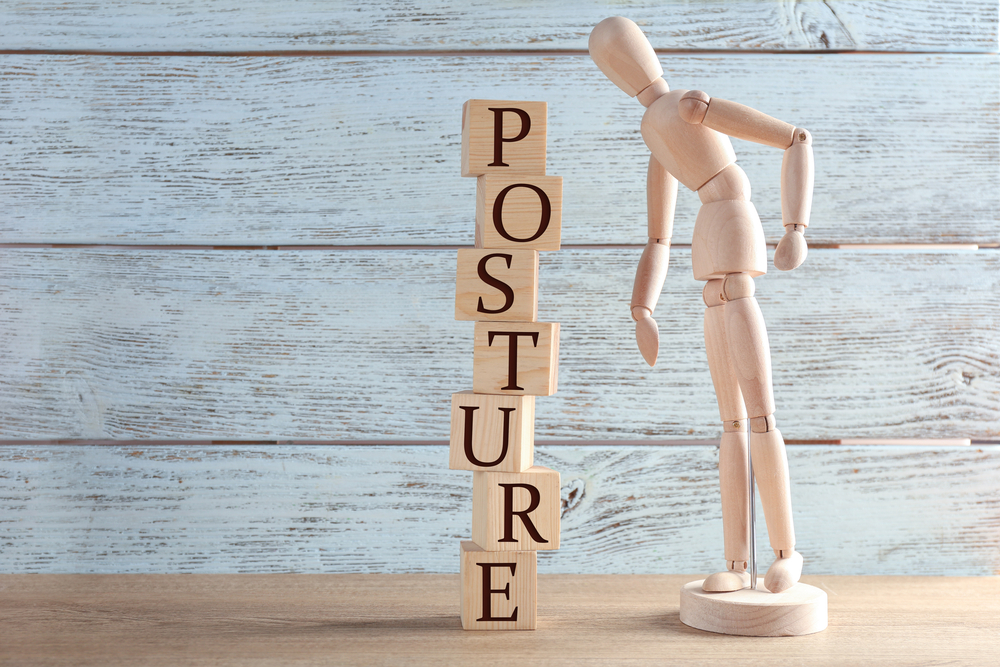 The American Chiropractic Association celebrates Correct Posture Month in May each year. Good posture is essential to maintaining the musculoskeletal balance of our bodies, which prevents harm to joints, ligaments, bones, and muscles. Proper posture can also help prevent muscle fatigue by allowing the muscles to use energy in the most efficient way possible.
That’s not all! Research shows that posture can impact your overall health and happiness in several other important ways.
1) Good posture can improve your self-esteem.
A study conducted by a team of researchers in New Zealand and published in the journal Health Psychology found that when participants sat up straight, they reported feeling strong, enthusiastic, and excited, whereas a slouching posture corresponded with feelings of fear, hostility, and passivity. Researchers also reported that subjects in the upright position maintained a better rate of speech and stronger pulse.
2) Good posture can ease symptoms of depression and increase positive thoughts.
Professor Eric Peper, a researcher at San Francisco State University has studied the connection between posture and mood. In one of Peper’s experiments, participants reported that upright posture naturally led to more positive thoughts. His research, as well as previous studies conducted by other researchers, point to a mind-body relationship that runs both ways: bad posture can lead to increased feelings of depression, while good posture has the potential to increase positive thoughts and lift your mood.
3) Good posture can increase feelings of power, self-control, and confidence.
Researchers from Columbia and Harvard universities conducted a study on posture and found that closed body postures, such as slouching inward, led to higher levels of the stress hormone cortisol compared to expanded body postures. Participants with expanded body postures reported feeling more powerful and confident. An assessment of desire to take risks also found that open body postures made participants feel more inclined to take risks.
4) Good posture can reduce back and neck pain.
It’s clear that good posture has some powerful mental and emotional effects, but good posture can also help reduce back and neck pain. Bad posture can lead to strain on the joints and ligaments, as well as muscle soreness. Over time, chronic bad posture can cause premature wearing of the spinal structures, as well as secondary problems like headaches. Good posture helps to maintain balance and support for all areas of the body.
5) Good posture can improve oxygen intake by as much as 30 percent.
Besides causing damage to the structures of the body, bad posture can also reduce your ability to intake oxygen. Author and physician Jacob Teitelbaum recommends sitting up straight with an expanded chest, which can increase oxygen intake by as much as 30 percent. The increase in the amount of airflow provided by good posture provides more oxygen to the brain and muscles, giving your body an overall energy boost.
How Can You Improve Your Posture?
With all the evidence pointing to the benefits of good posture, you may be wondering about the best way to improve yours. This May, start making posture a priority with these guidelines for better sitting and standing habits — habits that may help you feel better physically and emotionally.
While standing:
- Be sure your ears, hips, and shoulders are all lined up, and align your feet with your hips and shoulders.
- Keep your knees from locking by bending them slightly and bear your weight on the balls of your feet instead of your heels.
- Engage your core muscles, and roll your shoulders back to avoid slouching.
While sitting:
- Your weight should be evenly distributed between your “sit bones.”
- Don’t cross your legs, and keep your knees level with or slightly higher than your hips.
- In an optimal sitting position, your feet should be flat on the floor.
- While sitting at a desk your shoulders should be relaxed and your arms should be at a right angle, with your forearms parallel to the floor.
With so much of our lives spent either sitting or standing, keeping these tips in mind can go a long way toward improving your posture.
If you have any questions or would like more information about the benefits of good posture or how to improve yours, please don’t hesitate to contact us.
Wishing you a happy and healthy Correct Posture Month, from the team at Tuck Chiropractic Clinic!
About the Writer
tech
Headaches in the Back of the Head

Tuck Chiropractic Clinic specializes in comprehensive treatment for neck pain, low back pain, headaches, sciatica, and many other ailments. Chiropractic is effective for relieving pain and restoring proper function to the entire body.
Headaches in the back of the head are one of the more debilitating conditions we treat at Tuck Chiropractic Clinic.
The bad news is that these headaches are often caused by long-term postural difficulties. These postural habits are difficult to break and these headaches are tough to manage on your own. Typically, medications are minimally effective and these headaches quickly begin to ruin a patient’s life.
The good news is that headaches in the back of the head/top of the neck respond very well to chiropractic care. By adjusting the joints at the top of the neck, the muscles relax and the headaches improve quickly. When all the joints are moving well and the muscles are more relaxed, postural retraining is more effective.
One habit to be mindful of is having a chin-jut posture. If you are sitting at the computer or driving and your head is forward with your chin jutting out you are more likely to get a headache in the back of the head because those muscles get short and tight in that posture. Focus on keeping your chin back and feel as if you’re sitting tall to decrease these headaches.
If that doesn’t work, give your local Tuck Chiropractic Clinic a call for a proper evaluation!
If you suffer from neck pain, low back pain, sciatica, headache, or other issues dealing with the spine or body, call Tuck Chiropractic Clinic in Roanoke, the NRV, or Southwest VA today! We’re here to help!
About the Writer
tech
Sharpen the Ax

Tuck Chiropractic Clinic specializes in comprehensive treatment for neck pain, low back pain, headaches, sciatica, and many other ailments. Chiropractic is effective for relieving pain and restoring proper function to the entire body.
Abraham Lincoln once said if he was given 4 hours to chop down a tree, he would spend three hours sharpening his ax. The same should hold true for us as we enter spring, the season of increased physical requirements.
We often find ourselves in a position of “needing to count down a tree” this time of year. We have spring cleaning lists, gardens to prepare for the planting of flowers and vegetables, and repairs that need to be made to lawn equipment. Instead of rushing forward to take a bunch of hacks at that tree, it may be better to step back, assess our upcoming requirements, and properly prepare ourselves for what may come. We often overlook the biggest tune-up needed: our chiropractic adjustment!
Prior to lifting a bunch of “stuff” that should have been discarded long ago or crawling around the yard pulling weeds or sitting for hours on a lawn tractor, we need to make sure that these routine activities will not be leading us to painful and debilitating injuries. A good chiropractic check up is most certainly on my list of “To Do’s” prior to sitting on my lawnmower for a few hours. It’s easier for me to perform my yard duties with a tuned spine that to suffer through the weekend in pain and discomfort. Before I clean out and donate the clothes that my children have quickly outgrown, I ensure that lifting bags will not subject me to “throwing something out.” And, before my seasonal allergies have the opportunity to get into full swing, I get adjusted and start a hydration regimen that will help to keep the itchy eyes and sneezing at bay.
Make sure when you’re listing your yearly regimen that you include a trip to your local chiropractor so that they can help you “sharpen your ax” and keep you functioning through out the much anticipated upcoming spring.
If you suffer from neck pain, low back pain, sciatica, headache, or other issues dealing with the spine or body, call Tuck Chiropractic Clinic in Roanoke, the NRV, or Southwest VA today! We’re here to help! www.tuckclinic.com
About the Writer
tech
Happy, Healthy, RESTED Spines

The comment of the day in my office yesterday was, “I wake up with pain, and I don’t know why.” If you are waking up with pain, it probably has something to do with how you are sleeping. Posture is just as important when you are sleeping as when you are awake.
Patients often ask me, “What is the best mattress?” It’s really all about what is comfortable for you. Everyone is very different, but a good rule of thumb is to get a mattress on the firmer side. A mattress that is too soft will not provide good support for the spine. A mattress that is too hard may put pressure on trigger points on the back. Personally, I avoid the pillow top mattresses because you cannot flip and rotate the mattress. The key is to take your time and test out the mattress to make sure it is comfortable for you.
There are basically three body positions for sleeping. The best positions are either on your back or on your side. While lying on your back, you should put a pillow under your knees to take the pressure off of your low back. You also want a pillow under your neck that will support the curve in your neck. Feather pillows, while cozy, will guarantee that I wake up with a headache. They do not support the cervical curve like a contour pillow. If I am at a hotel, and I forget my to bring my pillow from home, I will take a small rolled hand towel and place it under my neck for added support.
Laying on your side is another good way to sleep. When on your side, you want to keep a pillow between your knees to keep your pelvis in a nice, neutral position. This will prevent a lot of low back pain because it alleviates stress on the sacroiliac joints. Again, you want to use one pillow under your neck, preferably a contour type of pillow, to give your neck the support it needs.
This brings us to sleeping on your stomach. This is not at all an ideal position for sleeping. It is harmful to both your low back and your neck. Try to break this bad habit if at all possible. For the stomach sleeper that just can’t break the habit, the best mattress is a firmer mattress. Even if you sleep one less hour a night on your stomach than you normally do, you are making your spine happier and healthier.
No matter what type of mattress you have or what position you sleep in, 8 hours of quality sleep is very important. If a patient is not getting enough sleep, the healing process for injuries will be prolonged. Enjoy your happy, healthy, RESTED spine!
About the Writer
tech
Proper Workstation Set-up May Improve Your Health

If you have ever heard the term “ergonomics” you may have taken some initiative to improve your desk at work. What you may not know is that you are actually improving your overall health as well.
Ergonomics literally means the “laws of work.” This term refers to “creating an environment where the equipment is made to fit the person and not forcing the person to fit the equipment.” A great example would be a car seat. Would you purchase a car where your head hits the roof and your knees straddle the steering wheel? Obviously you wouldn’t! So why would you sit in a desk chair that forces you to lean into the desk for support, bend your knees at an odd angle and put direct pressure on your wrists when you type?
Simple and cost effective strategies can be put into place to improve your posture, pain, and symptoms. Just ‘Google’ the word office ergonomics and you will be immediately overwhelmed by a number of helpful suggestions that are available to you. You could also follow these simple suggestions and find yourself more comfortable at work immediately.
- Place the top of your monitor at a height that is at your eye level. For most of you, this means lifting your monitor 6 inches or more.
- Place all your commonly needed items within arms reach. Your phone, printer, stapler and document holder should be with 2 feet of your hands. Reaching over and over will eventually put abnormal tension on your shoulders and neck.
- Adjust the height of your chair so that your knees can bend at 90 degrees.
- Once every 30 minutes, leave your workstation for 5 minutes. Once every hour leave your workstation for 10 minutes. Essentially, for every hour that you are working, spend 15 minutes moving around. Time your restroom breaks or grabbing a paper off of the printer.
- Finally, if after only a few hours at your workstation you are developing headaches, mid back pain or numbness in your hands, LISTEN TO YOUR BODY! Something is not working right. Get advice or help.
Our office is available to answer your questions. If you know your fellow employees are in need of help, we are able to present this information at your work. Ask the doctor for more information.
About the Writer
tech
The Fine Art of Choosing A Pillow

Every day I engage with a patient about “pillow talk.” When you consider the importance of how you spend 1/3 of your day, you can to see the relevance of this discussion.
First, the pillow must fit you! Not the other way around. Second, the pillow you choose will greatly differ from how you sleep. Basically, figuring out what position you sleep in most of the night. The damage that you cause to your neck from a poor or improperly fitted pillow will lead to problems with your spine. A Chiropractor will be able to help you recover from the damage, but stopping the pressure on the nerves must be the first priority.
Here are the basics. You need a pillow that is going to support a neutral posture the entire night. No other decision about a pillow will be as important as how it supports your neck and shoulders. Secondary considerations are allergies to the material and hygiene. Because of the oils in your hair and face, you should replace your pillow once every four to six months. Dust mites and bacteria will build up in almost any material and lead to allergies and poor skin. The oils will also flatten the pillow, changing how it supports you.
If you are a back sleeper, you will need a single pillow with a slight curve in it. This will support your spine while keeping your alignment neutral. Too small of a pillow will stress the lower part of your neck and too many or too large of a pillow will place excess stress on the upper part of your neck. Neither of which is conducive to a good nights rest. An excellent cervical curve pillow may be available from your Chiropractor.
Stomach sleepers, though not recommended, need a very thin pillow that will offer more cushion than support. A thin pillow will prevent excess pressure on the face and shoulders and again promote healthy alignment of your spine.
Finally, the side sleepers are the trickiest to figure out. They need a pillow that is going to fill the space between the side of the shoulder/arm and the neck. A pillow too small or too large with cause the neck to rest at an odd angle and will lead to AM stiffness and pain in the shoulder muscles. I recommend choosing a pillow at the store and keep the costs low ($4-$6), try the pillow out for several nights. If the pillow works well, go back to the store and invest in two or three more pillows of the exact brand and size. Then, replace the pillow once every four to six months to prevent thinning of the pillow due to oils from your skin.
Once you have found a pillow that fits you, always come back to the same pillow. If for any reason the pillow no longer supports you, start the process over and find the right pillow for your body. Again, 1/3 of your life is spent sleeping. Isn’t it worth the investment of time, effort, and money to find the right pillow?
About the Writer
tech
Sitting Can Be A Real Pain

We hear it all the time; “How could I be in this pain when all I have done is sit?”
Can sitting really cause pain? The answer, as I am sure you can figure out by my tone, is…YES! The main questions are, “Why does sitting cause pain?” and “How can I keep from getting pain from sitting?” Pain can result from when your spine is in a position that is not consistent with its normal posture. Spines have two concave curves and two convex curves. When you put your spine outside of these normal curves, over time micro injuries can result. These micro injuries progress to a major injury over time…a.k.a. PAIN!! Therefore, to prevent these injuries from occurring, you should attempt to keep your spine in these normal postures as much as possible.
For healthier sitting, we have adapted these suggestions from the American Chiropractic Association:
- Sit in a chair such that the curve in back of chair hits your back around your belt line
- Keep your shoulders “rolled back” rather than slumped forward
- Put your feet flat on floor with your thighs parallel to the floor
For a quick self-evaluation check this link out.
About the Writer
tech
Acknowledge Your Pain!
 For over 30 years, at Tuck Chiropractic we have treated literally thousands of patients. Most assume patients who consult a chiropractor to be very active people such as construction workers or athletes. However, these patients make up a very small percent of our practice. Across America, 40-50% of people are suffering from chronic back pain.
The chronic pain patients we see have injuries commonly known as cumulative type traumas.
These would be defined as small injuries, accumulating over time, into a major injury. To explain this to patients, I use this example: If you were to walk on the side of your foot all the time, eventually you will sprain your ankle.
If you are in pain, these are important questions to answer:
Is my pain new or reoccurring?
If you have never had this pain before and you can attribute it to a specific injury or activity, there is a possibility that no care is needed. Our suggestion is to apply ice to the area of pain for periods no longer than 20 minutes. If the pain does not subside, seek professional advice. If it is a reoccurring type pain, you could be developing a chronic pain condition. It is best to address this immediately. We find some of our patients are developing degenerative joint disease, an irreversible condition.
What if I cannot attribute my pain to a specific event?
Do you engage in activity regularly (perhaps working at a computer or working on a factory line)? This activity, over time, creates the same result as a single trauma. If this is the situation, a “two-pronged” approach usually is necessary. First, you must address the injury to get it to heal. Second, you must look at your activities and do what is called an ergonomic analysis.
No matter what the cause of your pain, you do not have to live with it. Pain is a signal in your body that something is wrong and should be corrected. Some of our patients explain pain away as a sign of old age. Whether you are 17 or 97 there are things that can be done to relieve your pain and get you back to living your life to the fullest.
About the Writer
tech
You may also be interested in...

Gardening Without Back Pain: Tips from a Chiropractor
Spring is a great time to get outside and enjoy gardening. But all the bending, lifting, and digging can be really tough… Read More

Spring Into Movement: Easing Back After Winter
After a long winter, it’s very common to feel more stiff, tight, and less mobile than usual. Cold weather, shorter days, and… Read More

Why Movement is Medicine for Back Pain
Your spine is designed to move. Every joint, disc, muscle, and nerve depends on motion to stay healthy. When movement decreases, the… Read More

5 Easy Habits for a Healthier Spine This New Year
The New Year is a great time to build overall healthier habits, but your spine is the backbone of everything you do. When… Read More